Seeking inner peace in a world that feels like a 24-hour news cycle on fast-forward? You aren’t alone. Many people turn to mindfulness to manage stress, but sitting still with your thoughts can feel more like a chore than a vacation. If you’ve ever tried to clear your mind only to end up thinking about your grocery list or that embarrassing thing you said in 2014, don’t worry—you’re doing it right. Today, we are diving deep into the top 5 meditation tips for beginners to help you build a practice that actually sticks.
Why Meditation is Your New Best Friend
Before we get into the “how,” let’s talk about the “why.” Meditation isn’t just for monks on mountain tops; it’s a scientifically backed tool for the modern brain. Research shows that regular practice can physically shrink the amygdala (the brain’s fear center) and thicken the prefrontal cortex (responsible for focus and decision-making). When you use meditation tips to guide your journey, you aren’t just relaxing—you’re literally rewiring your brain for better mental health.
For those just starting out, it’s vital to remember that isn’t about stopping your thoughts. It’s about changing your relationship with them. Instead of being caught in the current of a river, you’re sitting on the bank, watching the water flow by.
1. Start Small: The 5-Minute Rule
One of the biggest mistakes beginners make is trying to meditate for 30 minutes on day one. Unless you have the patience of a saint, you’ll likely end up frustrated. Our first of the meditation tips is to start with just five minutes.
Consistency Over Intensity
It is far more effective to meditate for five minutes every single day than it is to meditate for an hour once a week. Think of it like brushing your teeth. You don’t brush for three hours on Sunday and call it a week; you do it for two minutes twice a day. Meditation works the same way. By setting a low barrier to entry, you make it nearly impossible to fail.
- Set a timer: Use your phone or a kitchen timer so you aren’t constantly checking the clock.
- Morning rituals: Try meditating right after you wake up to set a calm tone for the day.
- Bedtime winds: Use 5 minutes before bed to signal to your nervous system that it’s time to sleep.
2. Find Your Anchor: Focus on the Breath
Your mind is a wanderer. That is its job. To keep it from drifting too far, you need an anchor. For most people, the breath is the most accessible tool available. It’s always with you, it’s free, and it happens in the present moment.
How to Use Breath Focus
Don’t try to change your breathing. Don’t try to breathe “deeper” or “better.” Just notice it. Pay attention to the sensation of the air entering your nostrils, the slight rise of your chest, and the fall of your belly. When you realize your mind has wandered—and it will—simply acknowledge the thought and gently guide your attention back to the breath. This meditation tip is the foundation of almost all mindfulness practices.
3. Create a Dedicated Space (Even if it’s Small)
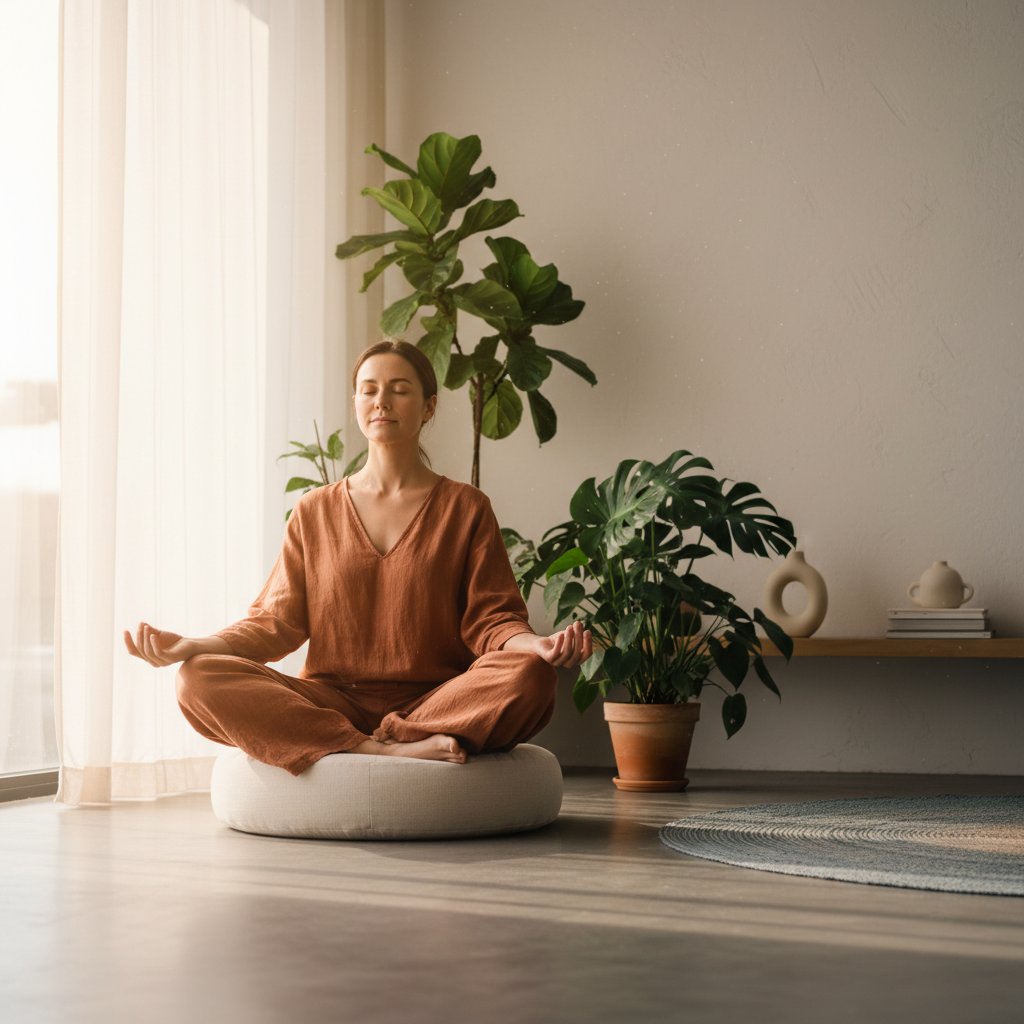
Your environment plays a huge role in your ability to relax. While you can meditate anywhere—on the bus, in the breakroom, or in line at the DMV—having a dedicated “zen zone” at home helps trigger your brain to enter a meditative state faster. This is one of the most practical meditation tips for beginners who struggle with distractions.
Building Your Meditation Nook
You don’t need a whole room. A corner of your bedroom or a specific chair in your living room will do. Consider adding elements that soothe your senses:
- Scent: Light a candle or use an essential oil diffuser with lavender or sandalwood.
- Comfort: Use a cushion (zafu) or a folded blanket to sit on. Comfort is key to preventing your legs from falling asleep!
- Lighting: Soft, warm lighting or natural sunlight is preferable to harsh overhead LEDs.
By returning to the same spot every day, you are using to build a habit through association.
4. Use Guided Meditations to Get Your Feet Wet
Silence can be intimidating. If you find the quiet too loud, don’t be afraid to use technology. Guided meditations are an excellent way for beginners to learn the ropes without feeling lost. A teacher’s voice can provide the necessary structure to keep you focused.
Where to Find Guided Content
There are countless resources available today. You can find free sessions on YouTube, or use popular apps like Headspace, Calm, or Insight Timer. These platforms offer specific tracks for anxiety, sleep, focus, and even “walking meditation.” Utilizing guided sessions is high on the list of meditation tips because it removes the guesswork of “Am I doing this right?”
5. Drop the Judgment: Embrace the “Monkey Mind”
The number one reason people quit meditating is the belief that they “can’t clear their mind.” Here’s a secret: Nobody clears their mind completely. The “monkey mind”—that restless, swinging-from-branch-to-branch activity—is a natural part of being human.
The Art of Noticing
The “magic moment” of meditation isn’t when your mind is quiet. The magic moment is when you notice your mind has wandered. That moment of awareness is a literal “bicep curl” for your brain. Each time you bring yourself back to the present without judging yourself, you are getting stronger. Be kind to yourself. If your mind wanders 100 times, just bring it back 100 times. That is the practice.
Advanced Habits to Support Your Practice
Once you’ve mastered these top 5 meditation tips, you can start integrating mindfulness into your broader lifestyle. Consider a to reduce the constant chatter of social media, or practice “mindful eating” by focusing entirely on the taste and texture of your food. These secondary habits support your seated meditation by making presence your default state rather than a special event.
Frequently Asked Questions (FAQ)
Do I have to sit cross-legged to meditate?
Absolutely not! While the “lotus position” is traditional, it’s not required. You can sit in a chair with your feet flat on the floor, lie down (if you won’t fall asleep), or even meditate while walking. The most important thing is a posture that is both alert and relaxed.
What is the best time of day to meditate?
The best time is whenever you will actually do it. Many prefer the morning to start the day with clarity, while others prefer the evening to decompress. Experiment to see what fits your lifestyle.
How long until I see results?
You might feel more relaxed immediately after your first session. However, long-term benefits like improved focus and lower stress typically become noticeable after about 8 weeks of consistent, daily practice.
Should I close my eyes?
It’s personal preference. Closing your eyes helps minimize visual distractions, but if it makes you sleepy, you can keep them open with a “soft focus” on a spot on the floor about three feet in front of you.
Conclusion: Your Journey Starts Now
Meditation is a skill, just like playing an instrument or learning a language. It takes time, patience, and a lot of gentle effort. By following these meditation tips—starting small, focusing on the breath, creating a space, using guides, and letting go of judgment—you are setting yourself up for a lifetime of mental clarity and emotional resilience.
Ready to start? Put your phone on “Do Not Disturb,” find a comfortable seat, and take one deep breath. You’re already on your way. What’s the most challenging part of meditation for you? Let us know in the comments below!